
Vehicle RC Verification API — Real-Time, Accurate, Developer-Ready
Instantly validate vehicle registration details with official RTO data. Built for scale, compliance, and fraud prevention
Build Faster Onboarding, Stronger Compliance, and Fraud-Free Systems.
Our Vehicle RC Verification API Services lets you instantly validate vehicle registration details in real time—with high accuracy, low latency, and enterprise-grade security.

Vehicle RC Verification API — Real-time Access to Official Registration Records
The Vehicle RC Verification API lets your team look up and confirm vehicle registration details directly from official RTO records, so you see the same information that appears on the registered RC document.
With VeriCore RC Verification API, you can verify:
- Vehicle owner name
- Vehicle class & category
- Fuel type & engine details
- Registration validity & status
- RTO information
- Registration number & date

How the Vehicle RC Verification API works
Onboard Customers Faster with Our Vehicle RC Verification API, Access accurate RC data instantly and eliminate manual verification delays.
Share the vehicle registration number through a secure API request.
VeriCore validates the number against official records to fetch accurate RC details instantly.
Receive standardized vehicle information—owner details, registration status, vehicle category, and more—in a consistent JSON format.
Use verified data to streamline vehicle onboarding, strengthen risk checks, and stay compliant—without manual intervention.
Key features of the RC Verification API
Pan-India Coverage
Verify vehicle registration details across India through a single API, enabling faster onboarding, reduced fraud risk, and consistent verification outcomes at scale.
Structured, Consistent Data Outputs
Returns normalized RC data fields with predictable schemas, reducing downstream validation effort and simplifying system audits and reconciliations.
Vehicle RC Verification API Built to Reduce Fraud — Not Slow You Down
Manual Verification vs VeriCore API
| Feature | Manual Verification | VeriCore API |
|---|---|---|
| Verification Time | Hours | Seconds |
| Accuracy | Medium | High |
| Automation | No | Yes |
| Scalability | Low | High |

What verification challenges does our RC Verification API solve?
Every day your team spends manually checking RC documents is a day your competitors are moving faster.
Onboarding held up by document queues. Approvals delayed because ownership can’t be confirmed. Operations stalled on RC uploads that may be tampered, expired, or simply wrong.
VeriCore’s Vehicle RC Verification API connects directly to official vehicle registration databases — the most authoritative source for vehicle registration data in India — and returns verified, structured registration data in real time. No intermediaries. No cached records. No guesswork.
Teams across industries rely on this infrastructure to verify RCs at scale — whether it’s ten verifications a day or ten thousand. If vehicle identity, ownership, or registration status is part of your workflow, this API was built for you.
If your process involves any of the following, you’re in the right place:
- Confirming vehicle ownership and registration status before approvals or onboarding
- Validating RC validity, hypothecation details, and expiry dates
- Checking vehicle class, fuel type, and chassis data as part of due diligence
- Detecting tampered, expired, or mismatched RC documents before they create risk
Here’s what our RC Verification API eliminates from your process:
Manual RC checks often lead to incorrect or incomplete data. The API automatically retrieves and validates registration certificate details, reducing human error and improving data accuracy.
Multiple verification steps increase operational friction. This API combines RC data extraction and validation into a single, streamlined request.
Traditional verification methods cause delays. Our RC Verification API provides verified vehicle registration data in real time, enabling instant confirmation and faster workflows.

Outdated or cached vehicle records can result in incorrect decisions. The API fetches live RC information so every verification reflects the latest registration status.
Unstructured data slows system integration. The RC Verification API returns standardized, machine-readable responses that plug directly into your existing workflows.
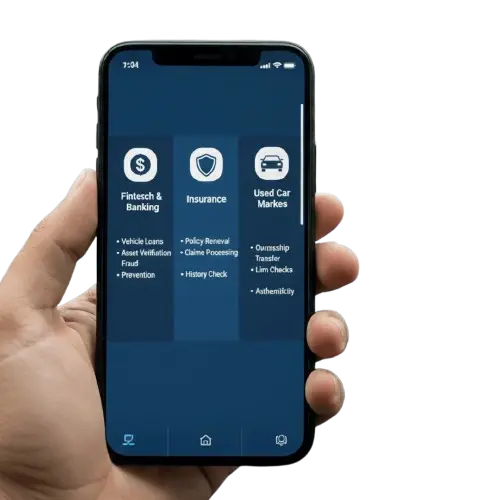
Use cases for Vehicle RC Verification API
RC Verification API — frequently asked questions
An RC Verification API is a digital service that verifies a vehicle's Registration Certificate (RC) using its registration number. The API retrieves vehicle details from authorized databases and helps businesses validate vehicle ownership, registration status, make, model, fuel type, and other key information in real time.
The exact response may vary based on data availability and permissions, but commonly returned information includes:
- Vehicle registration number
- Vehicle make and model
- Vehicle class and category
- Fuel type
- Registration date
- Registration validity
- RTO details
- Insurance status
- Fitness certificate status
- Permit details
- Ownership information (subject to privacy regulations)
A Vehicle RC Verification API lets you fetch a vehicle’s Registration Certificate (RC) details directly from official transport authority databases — instead of relying on uploaded photos, PDFs, or manual document checks. With a single API request, teams can see who owns the vehicle, whether the RC is active, whether it is under loan (hypothecation), and the recorded chassis and engine details. Businesses use RC verification in lending, insurance, mobility platforms, fleet operations, logistics onboarding, and fraud prevention — to replace manual RC checks, flag ownership mismatches, and speed up approvals.
The API is commonly used by: digital lenders and auto-finance platforms insurance onboarding and claims teams ride-sharing, delivery, and fleet platforms logistics and fleet management companies KYC, fraud, and risk teams used-vehicle resale and marketplace platforms If your process involves reviewing RC documents or confirming who owns a vehicle, the API lets you automate those checks instead of doing them manually.
RC Verification APIs are widely used across multiple industries, including:
- Banking and NBFCs for vehicle loan processing
- Insurance companies for policy issuance and claims verification
- Used vehicle marketplaces for seller verification
- Vehicle rental and leasing companies
- Fleet management providers
- Logistics and transportation businesses
- Fintech and RegTech companies for fraud prevention and compliance
These industries rely on RC verification to improve accuracy, reduce risk, and streamline vehicle-related verification workflows.
Typical fields returned include:
Owner name and vehicle registration number
RC status and validity
fuel type and vehicle class
chassis and engine number (masked where required)
hypothecation / financing status
RC issue and expiry dates
registering authority and state details
Some fields may not be available for every state or RTO, depending on what the authority records contain.
The API helps detect:
edited or tampered RC documents
mismatched owner vs applicant details
previously financed or duplicate vehicles
expired or invalid RC records
fake screenshots or fabricated RC images
Because the data comes straight from the transport authority, you don’t need to rely on screenshots or PDFs that could have been altered.
Yes — it supports:
real-time RC verification
bulk or batch verification
asynchronous processing for large datasets
fleet-level RC monitoring
Many teams plug it into underwriting systems, onboarding flows, or compliance dashboards where large volumes of RCs need to be verified.
Pricing is generally based on:
- Per-API call usage
- Monthly verification volume
enterprise or committed plansExact pricing depends on your expected volume and use case.
You can request:
API documentation
sandbox access
pricing and coverage details
a product demo for your workflow
Share your use case, industry, and estimated volume, and the team will help you get started with integration.
Enterprise plans typically include:
- Uptime commitments
- Faster support response times
- Dedicated onboarding assistance
- Pricing plans suitable for higher volumes
Yes — most platforms provide sandbox access where you can try sample RC lookups and test your integration.